
The air underground is not the air up top. It can be thin, it can carry gas that burns and it gets hot enough to hurt you. Most of the time you will not notice until the HUD tells you, so learn where to look.
Methane (firedamp)
Where. Methane is trapped in pockets in the limestone, between 160 m and 300 m. The rock holds small gas-charged lenses, roughly 3 to 6 m across. They are invisible and only show when you cut into them.
What it does when you open one. The pocket hisses and the gas bleeds out into the workings for hours. The game warns you the first time: "Hissing! A methane pocket opened in the limestone. No smell, no colour: get a gas detector (workshop) and set up a ventilation fan."
Where it goes. Methane is lighter than air. It spreads through the open space, rises, collects against the roof and in roof hollows, runs up shafts and escapes at the surface. A dead-end drift is the worst place: the gas has nowhere to go.
The numbers that matter
| Methane in the air | What it means |
|---|---|
| 0.5 % | The detector starts to beep slowly |
| 1 % | The detector beeps fast. Stop, ventilate |
| 5 % to 15 % | Explosive. A spark sets it off |
| Above about 18 % | It pushes the oxygen out: you lose air and, if it goes on, pass out ("Suffocated (methane)") |
At 2 % and above the detector beeps almost continuously.
The gas detector
Sold in the workshop for $650. Once you own it, the gas reading appears on the HUD in the vitals row, in percent, turning amber at 0.5 % and red at 1 %. It also beeps. Without it you cannot tell: methane has no smell and no colour.
What sets it off
The gas only burns if the air at that spot is between 5 % and 15 %. Then any of these can ignite it:
- A pickaxe or shovel striking hard rock. Each strike on rock has a small chance of a spark, more when the tool clanks off ground it cannot dig.
- Dynamite. A blast is always a spark. Never blast in gas.
- A running diesel machine deep underground, from its hot manifold and electrics.
Explosions run along the gas. A flash and a roar travel down the workings, and you hear it from far away. If you are inside the flame you take about 75 damage; the blast wave a few metres beyond it still hurts (up to about 32, falling to nothing at about 9 m). The game says "FIREDAMP EXPLOSION! The methane caught a spark."
Ventilation
A ventilation fan brings fresh air down a duct from the surface and dilutes the gas. In build mode (B, page Water & air):
- Ventilation fan: $1,800, 5.5 kW. Put it at the working face. It draws about 1.5 m³ of fresh air a second and dilutes the methane in about 14 m of gallery round it. It needs power: a live pole within 30 m.
It also takes a little of the heat out of the air round it.
What to do in gas
- Stop digging. Do not strike rock.
- Switch off diesel machines and get out of them.
- Walk back toward fresh air, away from the dead end.
- Set up a fan at the face and wait until the reading is under 1 %.
- Only then dig, and keep the fan running.
Heat
The rock gets hotter the deeper you go, and the air in a working takes the rock's temperature (a little less). By default the rock is about:
| Depth | Rock | What it is like |
|---|---|---|
| Surface | 15 °C | Fine |
| 300 m | 32 °C | Warm. Your body starts to feel it |
| 550 m | 45 °C | Hot |
| 850 m | 65 °C | Very hot |
| 1200 m | 100 °C | Extreme |
Near molten rock the air is hotter still. In a deeper world these depths stretch out in step with the layers.
Your body
Up to 31 °C air, your body copes. Above it your core temperature climbs, faster the hotter the air:
- From 38.5 °C you tire: stamina drains faster, and the game says "Too hot: your body temperature is rising."
- Above 40 °C you get "You're overheating! Get somewhere cool right now."
- Above 41 °C you take heat stroke damage every second, worse the hotter you get.
In 43 °C air (550 m) you are tired in about 8 minutes and in trouble in about 20 to 25. In 63 °C air it is a few minutes. Sitting in a machine's seat halves the rate. Cool air brings your temperature back to 37 °C.
Cooling vest. $2,500. Your core temperature rises roughly a third as fast. It is a must for the basalt layer.
Spot cooler. $6,500, 15 kW, in build mode, page Water & air. It blows air over a chilled-water coil and takes up to about 30 °C off the air within about 10 m, never below 16 °C. The water lines run up to a cooling unit on the surface. It needs power from a live pole within 30 m. Stand near it to cool off.
Diesels. A diesel overheats and stops if the air round it is above about 40 °C. It will not run until it has cooled down. A spot cooler near the work, or moving the machine somewhere cooler, fixes that.
The HUD
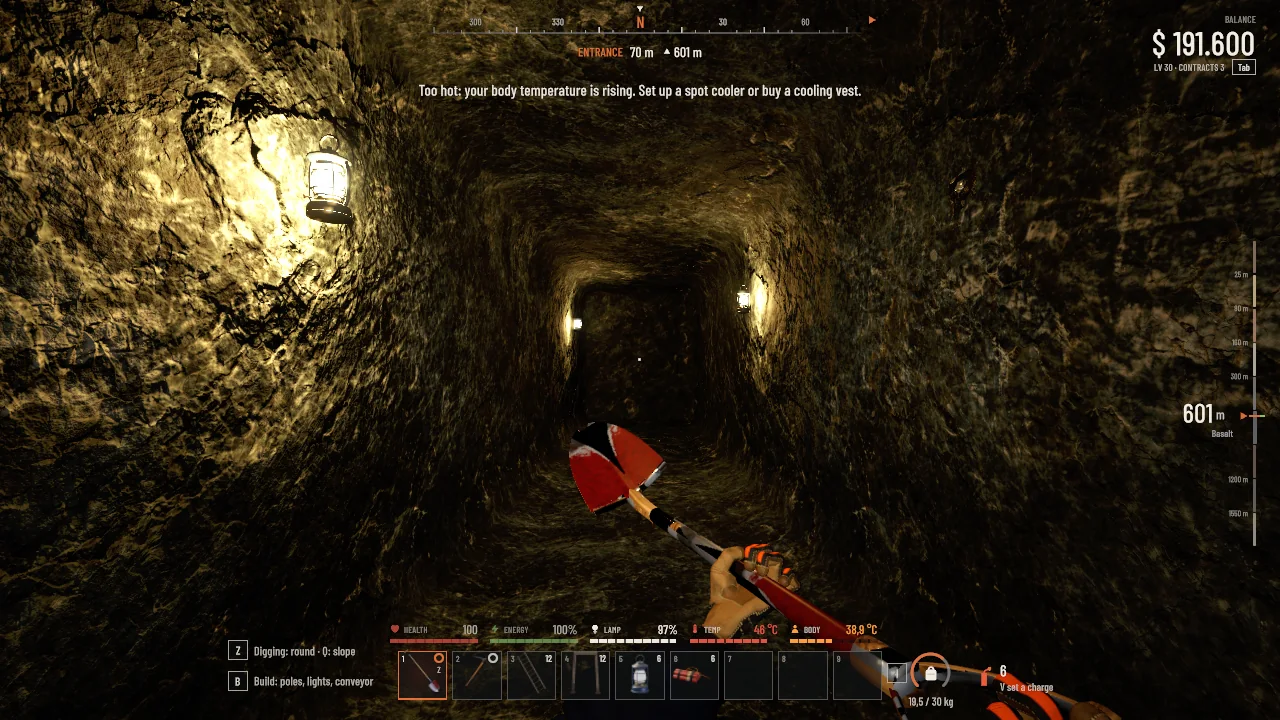
The row of vitals above the tool belt shows health, energy and lamp all the time. It adds:
- Breath, when you are buried, under water or short of air.
- Air temperature, when the air is warm (above 27 °C), amber above 31 °C and red above 40 °C.
- Body temperature, when it is above normal, amber from 38.5 °C and red from 39.5 °C.
- Gas, in percent, once you own a detector.
Tips
- Put the detector on your list before you reach 160 m. It is the cheapest thing that will save your life.
- Never run a diesel in a dead end without a fan.
- Dig a second way out. If gas builds up on one side, you can leave by the other.
- Heat is slow: if you feel hot, go up or cool the work area before the bar turns red.