
Some rock is too hard to dig by hand. Dynamite breaks anything, from granite to mantle rock. You drill a hole, load a charge, and fire from a safe distance. The rock fractures into loose broken rock you can shovel up.
Getting dynamite
Buy Dynamite x5 at the workshop for $450. It gives you five charges with detonators. The count shows on your inventory.
Controls
| Input | Does |
|---|---|
| Hold V at a rock face | Drill a hole and load a charge |
| Hold H (about a second) | Fire every charge you have set |
| Pad: hold LT at a rock face | Drill and load |
You can put dynamite on a tool bar slot too. While it is on the slot, the left mouse button does nothing, so you can't swing it by accident.
Step by step
- Walk up to the rock face. The hole is drilled where your crosshair is, within about 2.6 m.
- Hold V. A progress bar fills while the drill bites. Keep the crosshair on the same spot, or it stops and starts over. The harder the rock, the longer it takes: soft ground about 2 s, granite about 4 s.
- When the hole is done, the charge goes in ("Charge set (1). Set them all, then get 15 m away and fire with H."). It costs one dynamite.
- Repeat for more holes. More charges break more rock.
- Get at least 15 m away, or go behind a corner or solid rock, where 8 m is enough.
- Hold H. A 3-second countdown starts ("BLASTING! Everyone clear: 3 seconds.") and the other players get the warning in chat. It beeps.
- The charges fire one after another, 0.2 seconds apart.
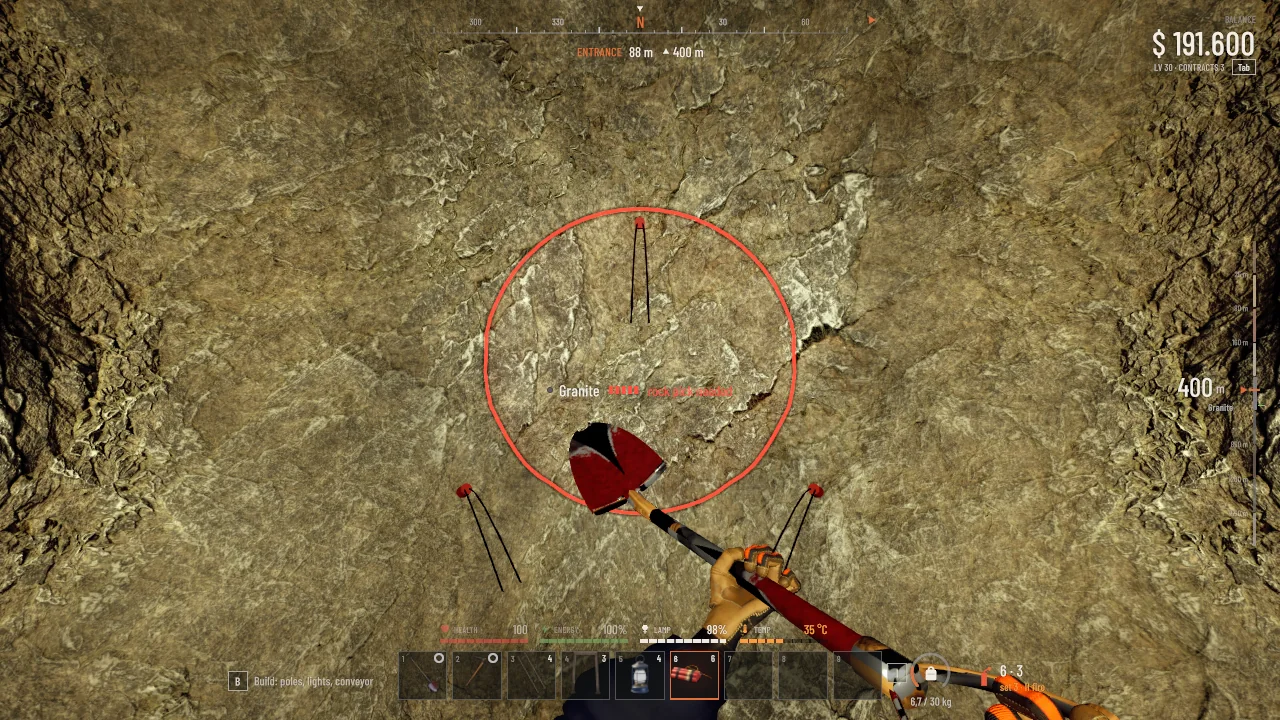
If you are too close, the game stops you: "Too close (6 m): get at least 15 m away, or behind a corner (at least 8 m)."
With the rock drill
If you hold the rock drill with air connected, a hole takes a quarter of the time. Granite goes from about 4 s to 1 s a hole. Hold V as usual.
What a blast does
Each charge:
- Digs out a crater about 1.3 m in radius, whatever the rock.
- Cracks the rock about 2.4 m around it into loose broken rock.
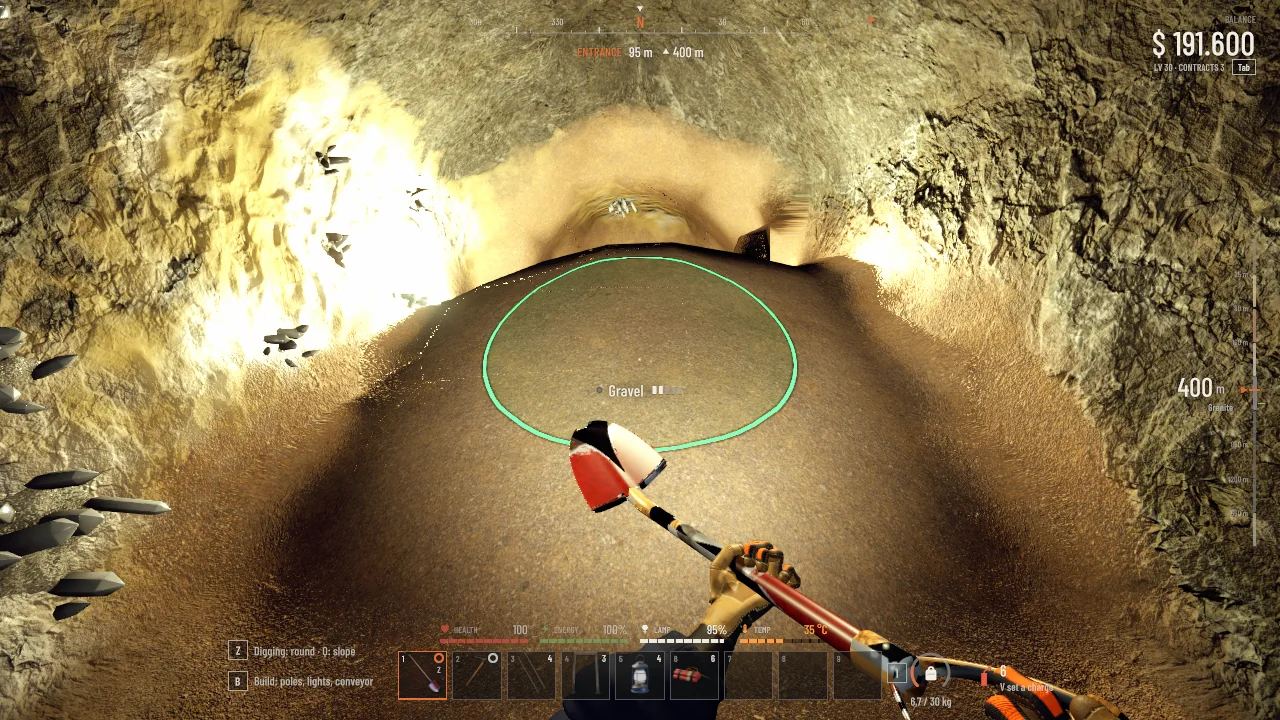
- Throws the muck into a pile 2.6 m in front of the face. Shovel it up (or use an excavator or loader).
- Frees ore in the rock as ore pieces.
- Shakes the camera, throws dust and sparks.
Finds in the blast are damaged, not intact. See finds. Keep blasts away from a fossil you want.
Safety
- Fly rock. Anyone in line of sight of the face within 14 m of a charge can be hit by rock thrown out of it, and it can hurt badly at close range. Stay 15 m away, or behind rock.
- Never blast in firedamp. A charge is a spark. In a gallery with methane (limestone layer, 160–300 m) the blast can set the gas off. A gas detector ($650) shows the methane level. Ventilate first (air, gas and heat).
- Tell your crew. In co-op the countdown goes to everyone's chat.
- Sand wakes up. Loose sand near a blast can start to slide.
What is protected
Blasts cannot break ground that is protected: the camp, the shaft collar of a winch, the footing of a built object, the field boundary, and the sealed core.
Not fired
If you leave without firing, the charges you set are put back in your box.
Tips
- Start with one or two charges and see what the rock does before you use a whole box.
- Blast with a corner behind you. A bend in the gallery is the cheapest safe spot.
- Hang a lantern near where you will stand, so you can find the way back in the dust.
- For regular drifting in granite, a drill rig called the jumbo drills whole 20-hole rounds for you (company level 6).