Buried in the rock are finds: pottery and old coins, mammoth teeth, ammonites, crystals and, in the clay, the bones of dinosaurs. Each one is a one-off site in the ground. Dig around it carefully and you add a page to your field notebook.
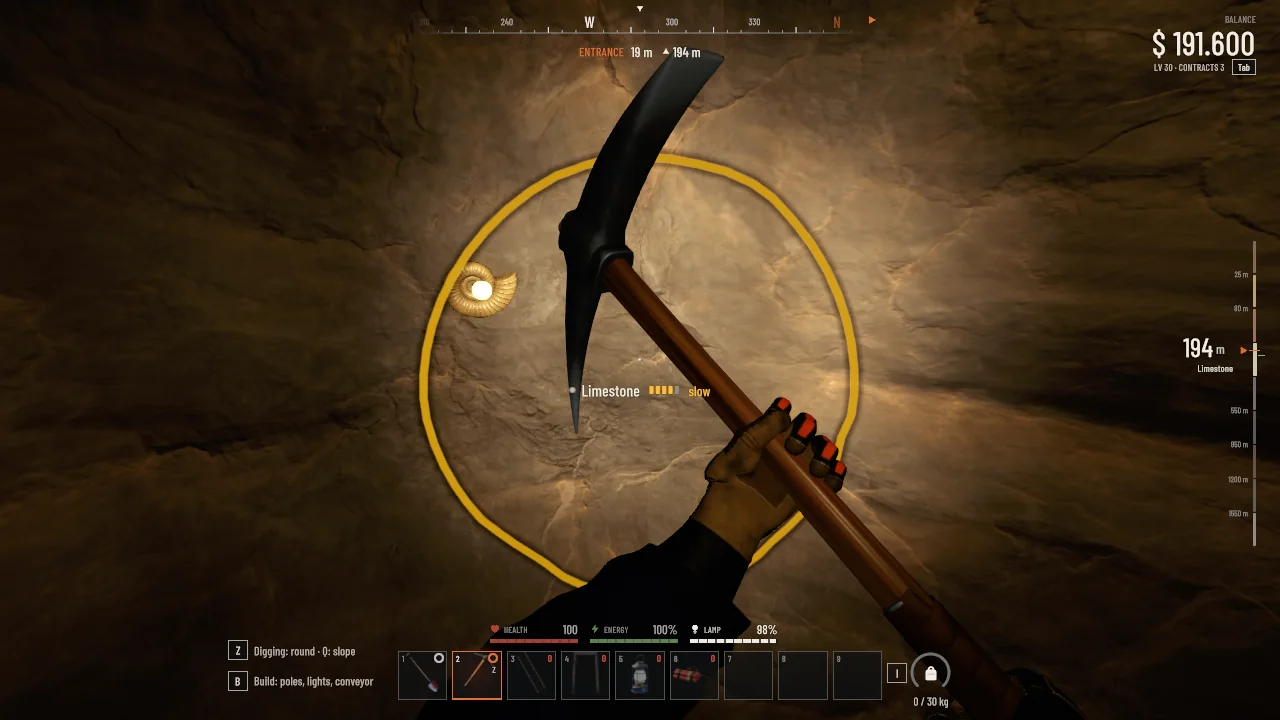
Digging a find out
A find is freed the moment the ground at its spot opens up. How that happens decides its condition:
| How it was freed | Result |
|---|---|
| By a hand strike (shovel, pickaxe, rock pickaxe, rock drill) | Intact. The first of its kind goes into your notebook. A duplicate goes into your spare stash |
| By a machine (excavator bucket or breaker, loader, dozer, TBM, roadheader...), a blast, or a slide | Damaged. It does not open a page and sells for little |
So whenever a find shows, go in by hand. Trim the rock around it with the pickaxe and let it fall out.
- A find shows as a glint in the wall once the rock round it opens.
- When a machine's cut is about to hit a find, the game warns you: "A fossil is close, dig by hand". An excavator's aim marker turns pale blue.
- Each site can only be freed once. When a find is freed, the site is gone for good in that world, even if you fill the hole.
What you can find, by layer
| Layer | Finds |
|---|---|
| Topsoil | Pottery sherds, Roman, Seljuk and Ottoman coins, iron arrowheads, old pick heads, oil lamps, mammoth tusk and molars, rarely a treasure chest |
| Sand | Petrified wood, shark teeth, megalodon teeth, amber (and amber with an insect), sea urchins, shell fossils |
| Clay | Leaf fossils, footprint slabs, dinosaur bones |
| Limestone | Ammonites, trilobites, crinoids, corals, fish fossils, starfish fossils |
| Granite | Geodes, quartz, amethyst, tourmaline |
| Basalt | Obsidian, olivine, zeolite, lava tube pieces |
| Upper and lower mantle | Xenoliths, peridot, diamond |
Finds are rare. You will walk past most rock without a single one. Rare ones, like the megalodon tooth or insect amber, are very rare.
The field notebook
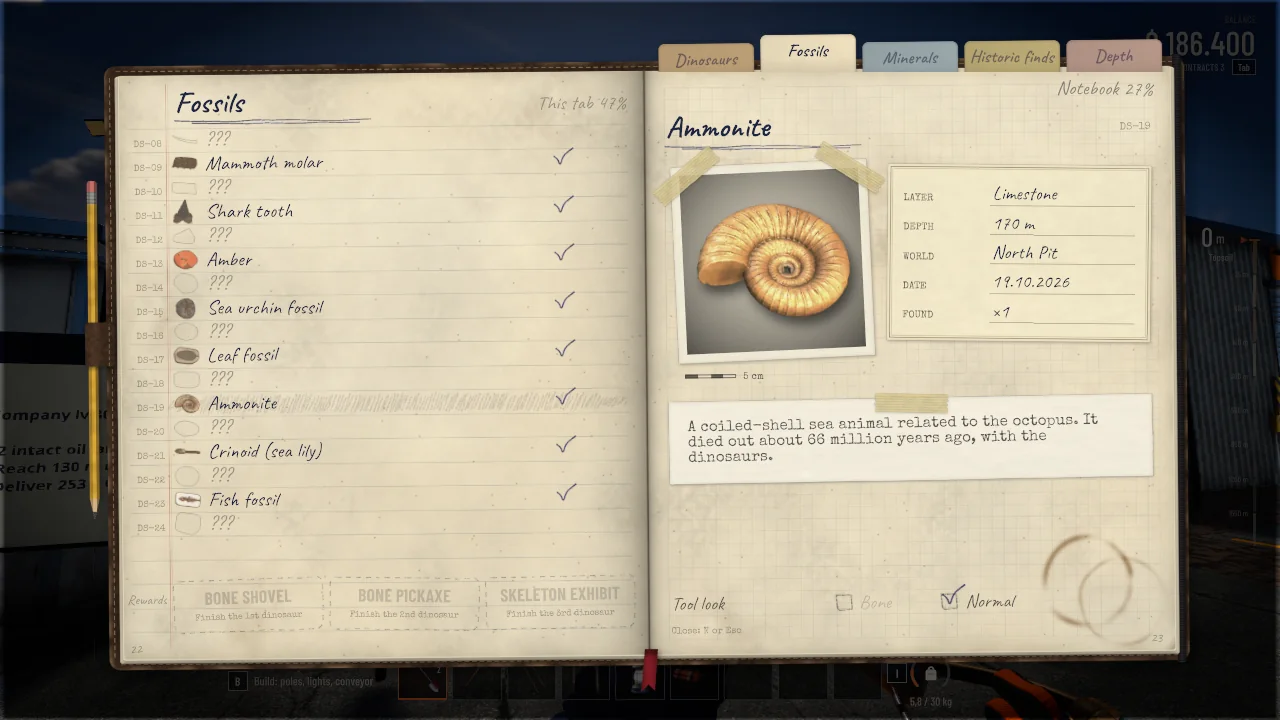
Press N to open your notebook and N or Esc to close it. It is yours, and it is kept between worlds: what you find in one game stays in your notebook in the next.
| Tab | Holds |
|---|---|
| Dinosaurs | The three skeletons, bone by bone |
| Fossils | Fossils |
| Minerals | Geodes, quartz, amethyst, tourmaline, obsidian, olivine, zeolite |
| Historic finds | Pottery, coins, tools, the chest |
| Depth | The deepest finds (lava tube pieces, xenoliths, peridot, diamond) and a log of the layers |
Keys: 1 to 5 change the tab, A / D or the arrow keys change the section, W / S or the arrow keys pick an entry.
An entry you have not found shows as a pencil outline with "???". Found entries show a sketch, a taped photo of the specimen, a label with where it comes from, and a note about the real thing.
Duplicates and damaged finds
- The first intact find of a kind goes into the notebook ("Added to your notebook: ...").
- After that, an intact find is a spare piece ("Spare piece: ... Sold at the sales hatch"). It sells for roughly half its value.
- A damaged find ("Damaged find: ... It did not open in the notebook; it sells for little") sells for roughly a tenth to a fifth.
Spare and damaged finds are sold with your ore at the hatch, and the sale shows as "Finds +$...".
Dinosaurs
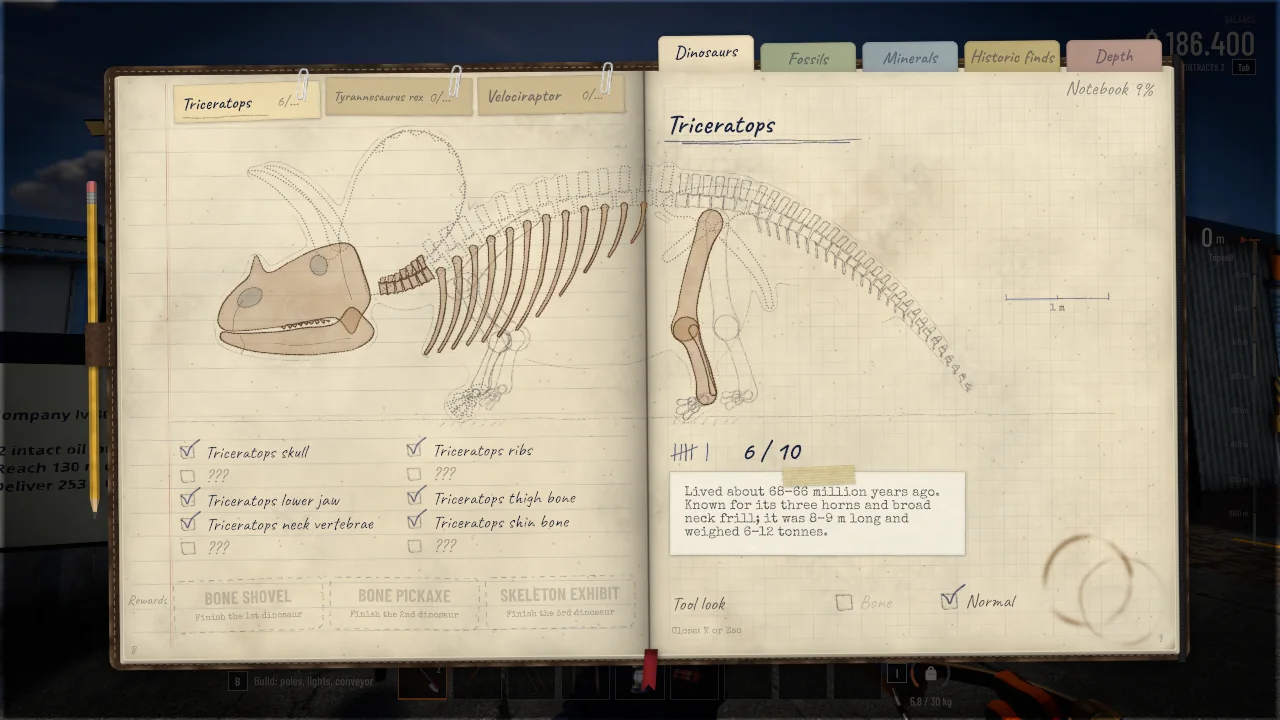
The clay layer holds the bones of three dinosaurs: Triceratops, Tyrannosaurus rex and Velociraptor. Each skeleton has ten bones. The notebook shows each skeleton drawn across the page and the bones you have found so far, with a tally ("7 / 10").
- Bones are just another kind of find in the clay: free them by hand to keep them.
- The bone you get is decided when it is freed, and the game leans toward bones you do not have yet.
- Each dinosaur lives in its own band of depth in the clay.
- Complete a skeleton and the page is stamped COMPLETE.
Rewards
The rewards come in the order you complete the skeletons. They stay with you in every game.
| Skeleton completed | Reward |
|---|---|
| 1st | Bone shovel: a bone-white shovel that digs 5 % faster |
| 2nd | Bone pickaxe: 5 % faster than the normal pickaxe |
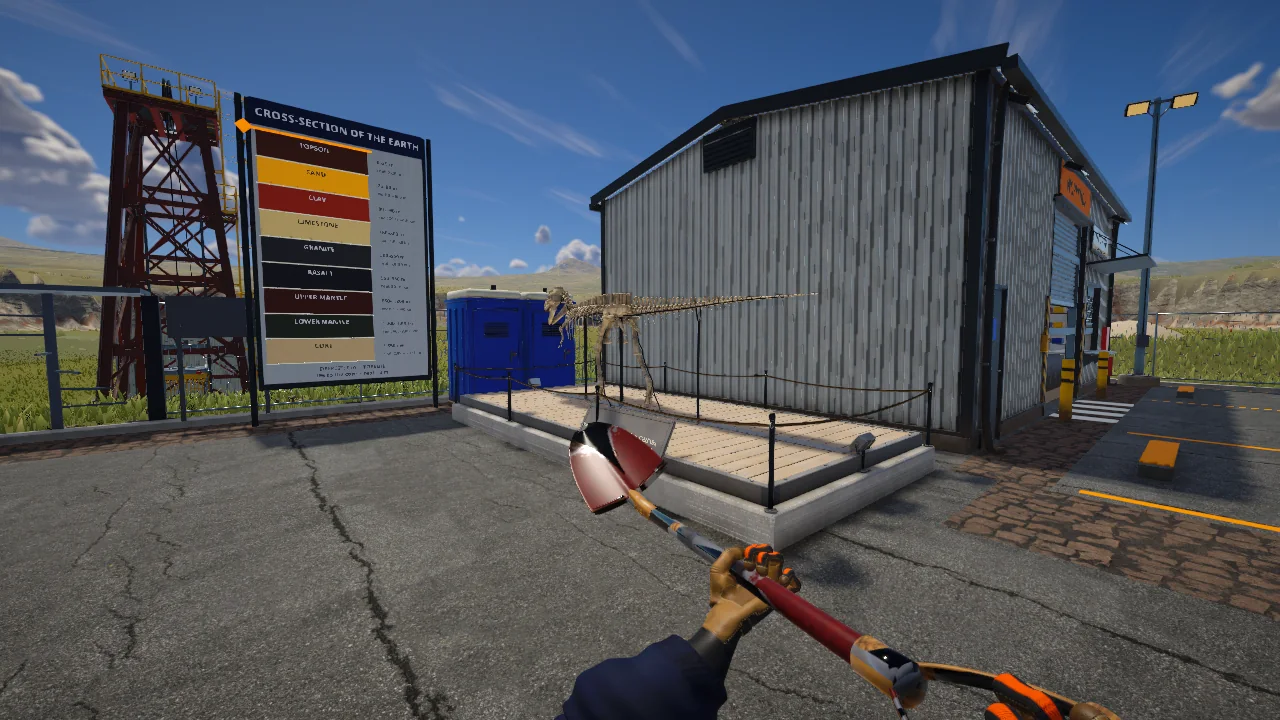
| 3rd | Skeleton exhibit: a full mounted skeleton of that dinosaur on a pedestal in your camp, with a plaque showing who found it and when |
In the notebook's Tool look box you can choose between the Bone look and the Normal one. The look is only cosmetic: the speed bonus stays. The other players in a co-op game see your bone tools and your exhibit.
Museum contracts
Some contracts on the job board ask for intact finds for the museum ("An intact ... for the museum"). You deliver them from your spare stash at the sales hatch. A museum contract pays about three times the value of the pieces, plus a small fee and company experience. They only ask for finds from layers you have reached and that are not too rare there.
Co-op
Each player has their own notebook. Two players cannot free the same find: whoever claims it first gets it, and the others are told ("... found a ..."). The first of a kind goes in the finder's notebook, so dig your own.
Tips
- Approach a find with the pickaxe, a bite at a time, and do the last strikes by hand.
- Do not use an excavator in a layer that holds the finds you want. If you want to clear space, work by hand around the glint first.
- Sell duplicates at the hatch, or keep them for a museum contract.
- The clay layer is where the dinosaurs are. Expect a long project.