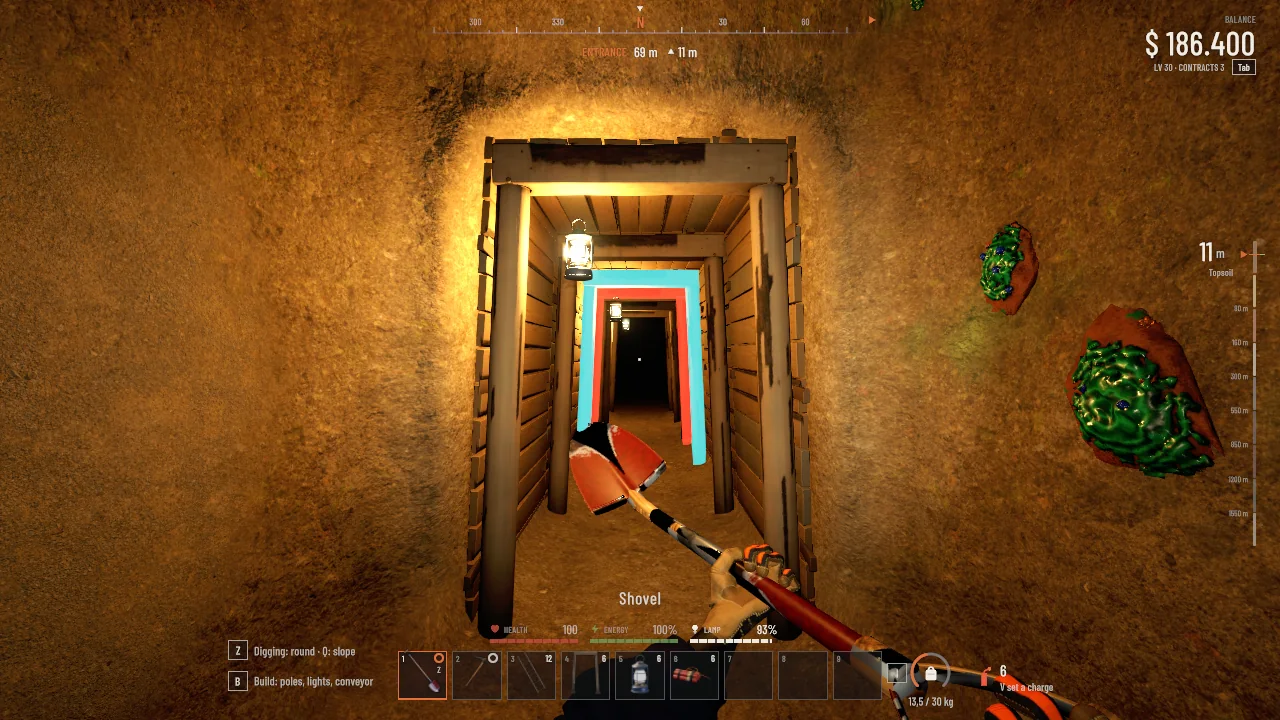
Timber sets hold up the ground round a drift. A set is the classic mine "door": two leaning posts on footblocks and a cap across the top. Put sets in a row and the game boards in the space between them, which turns a rough hole into a proper drift.
What a set does
- It holds the ground round it: about 2.6 m around the set and 4.5 m above it. Falling and sliding soil keeps out of that space, and with the Sand cave-ins setting on (see cave-ins) sand does not fall or slide there.
- In granite it stops rock bursts. Where a set stands, the wall does not burst (see cave-ins).
- Once two sets line up, the gap between them is boarded: roof boards over the caps, wall boards behind the posts, and wedges between boards and posts. The boards hold the ground behind them and keep your drift clean.
A set is about 2 m wide. It is sold with one bay of boards and wedges, so you do not pay extra for the boards. It costs $20 in the workshop. A new world starts you with three.
Putting a set down
- Pick the set on your belt (slot 4 at the start, or use the mouse wheel).
- Look at the floor of the drift where you want it, within about 3.6 m. While you look along the drift, the set goes on the floor under the point you are looking at, so you do not have to look down.
- A see-through ghost shows where it will go.
- Left click to place it.
| Ghost colour | Meaning |
|---|---|
| Cyan | The set lines up with a row, or with the direction of the drift |
| Amber | It goes exactly where you aimed (not lined up with anything) |
| Red | It cannot go there; the line at the bottom tells you why |
Press Q (on a pad, the left trigger) to switch between lined up and free. Lined up is the default.
Lining up
- The first set of a drift turns to the direction of the gallery and centres itself between the walls.
- A set put near another one takes the same direction, the same floor slope and the row's own spacing. If the row has no spacing yet, the gap is what you aimed at, between 2 and 3 m (2.5 m if you aim ahead).
- When two lined-up sets are between about 1.2 and 3.3 m apart, the game puts the boards in between. The ghost shows the boards too, and the prompt says "The gap gets boarded".
- If a set stands near but is not lined up, the prompt says that no boards will be put between them.
Filling a row from a distance
If you dug on past the last set, you do not need to walk back. Aim along the row at the ground a few metres ahead, up to about 8 m from the last set, and the next set goes at the row's free end, next to the last one, with its bay boarded. The prompt says how far back it will go. Click again to fill the next gap, and so on, step by step down the drift.
"Dig first"
A set needs room. The inside of the frame, and of any bay of boards it closes, has to be dug out already. If solid ground is still in the way you see a red ghost and the line "Dig first: the set's space isn't open yet". Small bumps are not a problem: placing a set trims the walls and roof back to a clean outline, up to about 30 cm deep, and packs small hollows behind the boards with soil.
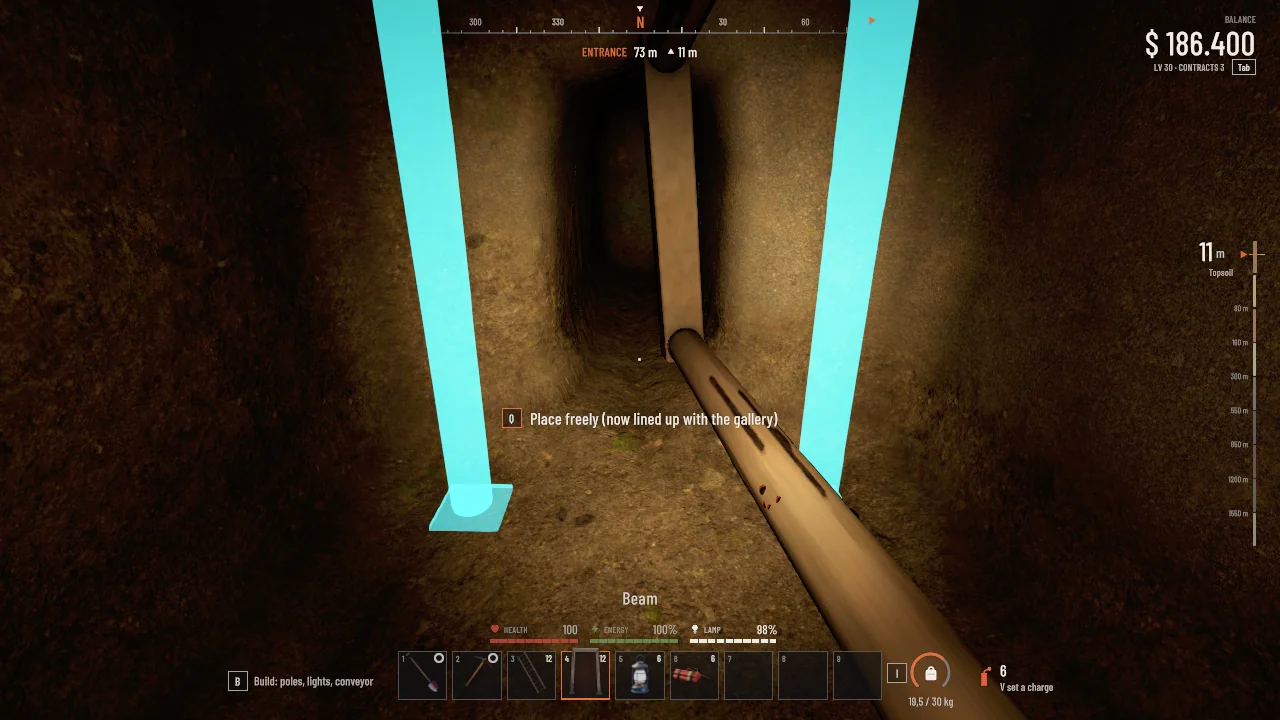
A set also holds ground, so it will not stand in the open. The game refuses it:
- on the camp site ("A beam set can't go on the camp site: put it in a drift, shaft or trench you dug"),
- where there is not enough ground round it to hold ("There is no ground for this beam set to hold"),
- on top of another set,
- on a floor that is too steep.
Once the boards are in
You can no longer dig into ground that the boards are holding. With a hand tool you get a clank and the message:
- "You can't dig behind the boards: the lagging holds the ground." when you strike the wall or the roof behind boards.
- "You can't dig under a support set: it would come down. Take the set back first (E)." when you strike the floor under the feet of a set.
If you really want to open that ground, take the set back first.
If something does take the ground out from under a set (a machine, a blast), the set comes down as an item with its boards and you can pick it up again.
Taking a set back
Look at the set and press E. It goes back into your bag and the boards between it and its neighbours go with it.
Controls
| Action | Keyboard / mouse | Pad |
|---|---|---|
| Select the set | 4 at the start, or the mouse wheel | LB / RB |
| Place | Left click | RT |
| Lined up / free | Q | LT |
| Take back | E on the set | West button |
Tips
- Put the first set in before the drift gets long. It is easier to fill forward than to patch afterwards.
- Dig the next bay, then fill it with the free-end trick, instead of walking back each time.
- Boards only form between two sets that stand in a straight line, about 1.2 to 3.3 m apart. Sets that are not lined up get no boards between them.
- Keep a spare set or two in your bag for emergencies in the granite.