
Underground the ground can come down in a few ways (sand only if you switch it on, see below). Some are loud and warn you first, some are quiet, and one is your own doing. This page tells you what each one looks like, what it does to you and how to stay out of trouble.
What actually falls
Blocks you cut loose
If you dig around a chunk of ground until it hangs free, it does not float. The block drops, breaks up and lands as a heap of loose soil on the floor under it. The soil is not lost: you can shovel the heap or haul it away like any other soil.
This happens with every way of digging: shovel, pickaxe, machines, blasting. It matters most in three situations:
- You cut the neck of a block that hangs from the roof. The block comes down as a heap. (A pillar that still stands on the floor and touches the roof stays up.)
- You dig round a block from several sides and the last cut frees it.
- A blast frees a slab from a roof or wall.
Only blocks of a limited size fall this way (up to about 64 m³ of ground). A huge mass that is still joined to the rest of the ground stays where it is, and so does anything that is joined to the ground at one point. Ore in the block drops out as ore pieces.
Things you have put up that depend on the ground go with it: if you dig the ground away from under a placed lantern, ladder or beam set, it comes down as an item you can pick up again (see ladders and lights and supports).
Rock bursts in deep granite
Granite lies between 300 and 550 m. The rock there is under a lot of stress, and every hole you open in it releases some of that stress into the walls round it. For a while afterwards, a slab can let go.
A burst has a warning:
- The rock cracks and grit trickles from the wall. If you are within about 18 m the screen says "The rock is cracking!".
- About two and a half seconds later a slab roughly 1 m thick blows out of the wall and throws rock across the opening.
The rock is thrown away from the wall. Within about 5 m of the slab, in a straight line from it, the flying rock hurts, and the closer you are the more it hurts (up to 50 damage). Behind a corner or behind other rock it does not reach you. Walls tend to burst more than floors and ceilings.
The stress fades over about ten minutes, so a fresh, big opening in granite is the dangerous kind. The deeper you are, the more likely it is.
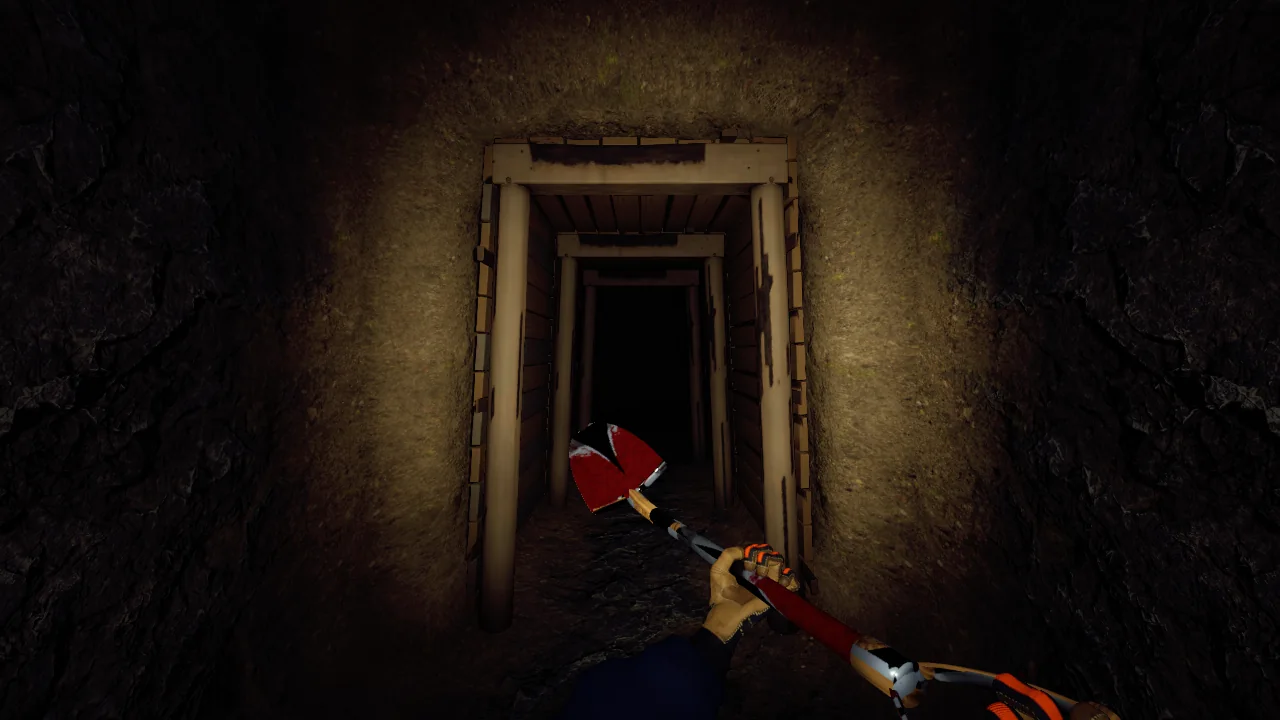
Timber sets stop it. Where a timber support set stands (about 2.6 m round it and 4.5 m above it) the wall does not burst. A row of sets down a granite drift is the cure.
Soil on top of you
Loose soil from a heap, a dumped load or a falling block can fill the space where you stand. If your head ends up inside solid ground you are buried. Then:
- The breath bar appears and drains: you have about 12 seconds.
- Once it is empty you take damage every second until you are out or you pass out.
- You do not heal while buried.
- The game also tries to push you up out of the ground by itself if it can find open space within a few metres above you.
If you are buried and the game does not free you, dig. Swing the shovel at the ground in front of you and keep going upwards towards where you came from. The less you waste, the better: 12 seconds is not long.
Sand cave-ins (a setting, off by default)
Sand is the one ground that can come down by itself, and it is switched off in a new game: sand you dig stays where you leave it, like soil. If you want the full risk, turn it on in Settings > Sound & controls > Sand cave-ins (Off or On). In a session the host's setting counts for everybody; a guest who changes the switch is told "The host decides this."
With the setting on, sand follows these rules (sand only: the soil above it and the clay and rock below it stay up). The sand layer starts 25 m down.
- A ceiling with sand on all sides holds for a while. A wide roof gives way after 14 to 32 seconds in the sand layer (sand flows at half speed). Just before a piece lets go, grit drips from it and it creaks, so you hear it coming. That is your time to put a timber set in.
- A thin ceiling drops almost at once: a lump hanging from the roof, a narrow shelf, the edge of a chamber. Expect it within one to three seconds.
- Walls slide. Sand at the edge of a cut falls down and sideways to a natural slope of roughly 45 degrees. Not every grain goes at once, so a wall slumps for a while and then runs out.
- Timber holds it. Sand does not fall or slide within about 2.6 m of a timber set, or between two sets that are boarded in. A drift lined with sets stays open.
- It keeps going. When a piece of ceiling falls, what rested on it may follow, and a fresh cut can set off its neighbours.
A fall of sand can bury you (see Soil on top of you above): dig up and out at once, and put a set in before you open more than a chamber's width of sand roof. With the setting off none of this happens in sand. Loose piles that a machine or a falling block has dropped settle and spread at a natural slope either way, so do not stand under the face of a steep heap.
Staying safe
The rules are short.
- Never dig under a block you are standing on, and never leave a pillar half cut. Finish the cut from the side that is not underneath.
- In granite, support the drift early. Put the first set in before you have opened a long stretch.
- Listen. Cracking and creaking is the warning. When you hear it, walk away from the wall. Getting 8 to 10 m down the drift is usually enough.
- In sand (with the setting on), prop before you widen. Put a set in as soon as a roof gets wide, and never work under a lump or shelf.
- Leave by the way you came. Do not dig yourself into a dead end with no ladder behind you.
- Keep your lamp charged. Digging in the dark is how people dig into the wrong block.
Tips
- A fresh heap on the floor is soft. If you cut a block loose above a gallery, the heap may block the way; shovel it into a barrow.
- After a blast in granite, wait a few seconds before walking into the dust. A rock burst can follow a big opening.
- If you hear cracking while you are inside a timbered stretch, you are fine. If you hear it outside one, move in.