
Soil you move with a machine does not vanish into the ground and does not stay in neat blocks. It becomes loose material: a real pile that flows, slumps and settles. This page explains what it does and how to use that.
Four kinds of soil
Loose material comes in four kinds. The kind decides how the heap behaves.
| Kind | Resting angle | What it is like |
|---|---|---|
| Dirt | about 35 degrees | Middle of the road. |
| Sand | about 33 degrees | Flows most easily. Makes the flattest heaps. |
| Gravel | about 39 degrees | Steeper than dirt, still runs when it is disturbed. |
| Clay | about 45 degrees | Cohesive: it holds steep faces and falls in lumps, not as a flow. |
The resting angle is how steep the side of a heap gets before it slides. Pour sand on one spot and it spreads wide and low; pour clay and you get a tall, blunt cone.
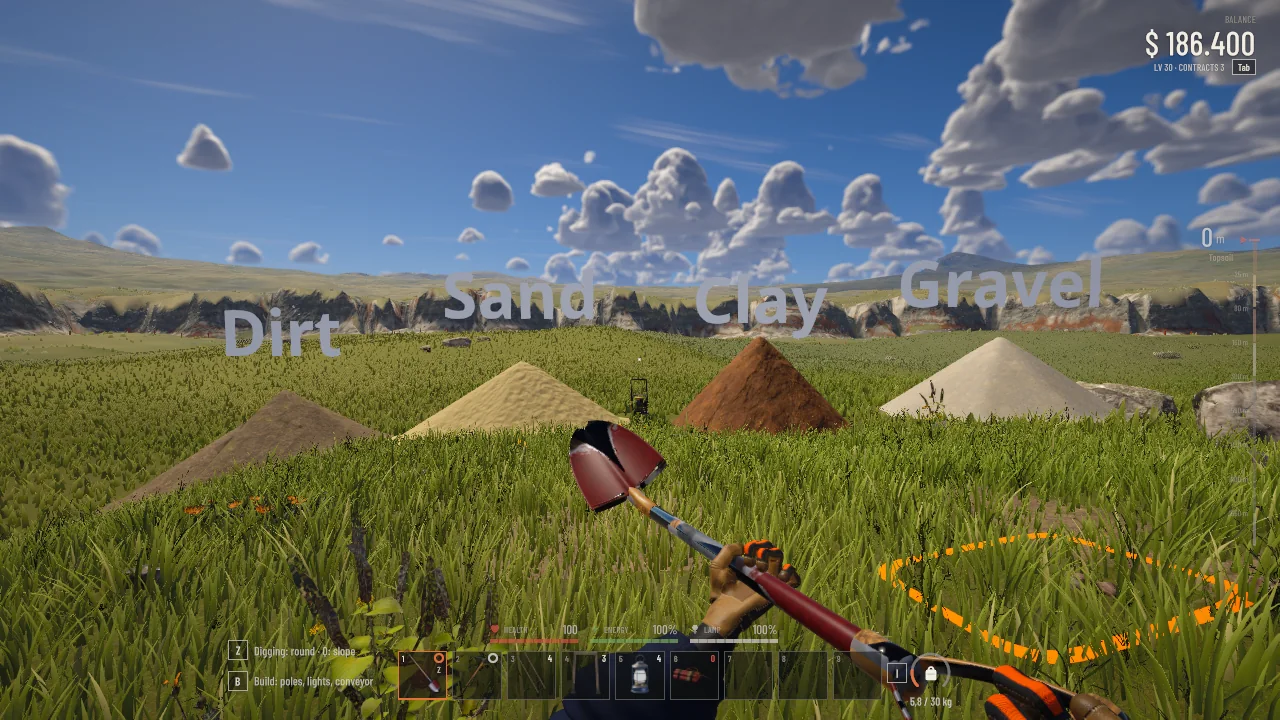
What makes a heap
Anything that puts soil on the ground makes loose material: a truck tipping, the excavator or loader dumping, the dozer's blade, the excavator's push, a shovel or a wheelbarrow. Nothing is lost on the way. What you dig out is what you get in the heap, and what a bucket takes from a heap is taken from it.
- Truck tip. Soil runs out of the back and builds a cone. Creep forward while the body is up to lay it out in a ridge instead.
- Bucket dump. An excavator, a loader or a dumper pours its load and the stream builds a cone under it.
- Lift spill. An excavator that lifts an overfull bucket drops a little from its side plates onto the ground.
- Blade overflow. A dozer carrying more than its blade holds spills it round the ends of the blade.
Moving it
Loose heaps can be pushed, scooped, dug and levelled:
- the dozer pushes a heap along as a rolling pile ahead of its blade, and part slides round the ends;
- the excavator pushes with the right mouse button, which is the quickest way to spread a heap out;
- the wheel loader and the excavators scoop it. A bucket drawn through a heap takes soil from the face and the walls cave in behind it;
- you can shovel it by hand;
- the roller and plate compactor flatten it and make it firm.
Moist soil
Soil that comes from deep in the ground, or from the water-bearing layer, is moist. Moist soil is darker and stands at a steeper angle, about 43 to 48 degrees for dirt and sand. Soil from near the surface is dry. Soil dug from below about 1.2 m is already a little damp; below about 3 m it is half moist; and soil from the water layer or from standing water is fully moist. A load keeps its moisture in the bucket, the truck, the heap and a saved game.
Moist heaps are good for steep banks and ramps, and dry sand is the worst for them.
In a truck bed
The same rules apply on a steel truck bed: a load slides out as one mass when you tip the bed past the friction angle of the soil on steel. Sand lets go at the shallowest angle, gravel and dirt later, clay last.
Setting into the ground
A loose heap stays loose while something is happening to it. When nothing has touched it for about six seconds, or when every player is far away, the heap sets: it is folded back into the ground and becomes solid terrain you can dig with a shovel or a bucket as usual. A set heap can look rounder and a bit smaller than the loose heap, because the ground is built of half-metre cells; when you dig it, it opens up as loose material again.
A heap that has set is still fresh fill for traction: vehicles still sink into it until it is compacted. See compaction and trucks and dumpers.
Grass under a heap is pressed flat, and hidden once it is more than a couple of centimetres deep. The meadow underneath a thick heap becomes plain dirt.
Underground
Under a roof a heap cannot grow into the ceiling: it fills the room up to the roof, and what does not fit moves to the nearest place with room. A conveyor that fills a worked-out gallery (backfill) stops when the heap reaches the roof. A narrow place fills quickly.
Natural sand layers in the ground are a separate thing: they cave in when undermined, and a ceiling of sand holds only for a while.
Tips
- To build a ramp or a pad, tip in layers, spread each with a dozer and roll it.
- Do not make a tall heap of sand or gravel and then work under it. Clay and moist soil stand steeper and are safer.
- A heap on the meadow kills the grass under it: choose where you tip.
- If an area of loose fill is in your way, push it aside with the excavator's right mouse button instead of scooping it all.