Processing turns raw ore into more money. You do not need it: raw ore still sells. But a line of machines that digs, crushes, sorts and smelts for you pays well and works while you are somewhere else.
Unlocking it
Buy the Ore processing plant in the workshop (Site tab, $6,000, company level 3). It is a licence plus the foundations and installation kit for all four machines. Then you build them piece by piece:
| Machine | Where in build mode | Price | Level | Power |
|---|---|---|---|---|
| Auto-digger (auger) | B → Deep machines | $9,500 | 3 | 30 kW |
| Jaw crusher | B → Processing | $12,000 | 4 | 22 kW |
| Sorter (screen and picking line) | B → Processing | $6,500 | 3 | 7.5 kW |
| Smelter | B → Processing | $14,000 | 4 | 5.5 kW coal-fired, 75 kW electric |
All of them need power. They show "no power" in their status if no pole is within 30 m, or "fuse tripped" if the network is overloaded. See Power and light.
Look at a machine to read its status, and press E to start or stop it.
Auto-digger
The auto-digger is an electric auger miner. Place it facing a wall. It bores a straight round hole about 1.6 m wide, up to 30 m deep, and carries the spoil back on a tail belt into a bunker or onto a heap.
- Speed depends on the rock: about 5.4 m/min in soil, 1.7 m/min in limestone, 0.9 m/min in granite (30 kW). The prompt shows the current rate.
- Standard head: cuts up to limestone. Granite needs the Auto-digger: carbide cutter head, an upgrade for $8,000 (level 5) in the workshop.
- Stops at rock it cannot cut, at water (pump it out, then press E), at gas (ventilate first), at lava, at protected ground and at the edge of the claim. When it has bored 30 m, it stops. Take it down in build mode with X (it refunds 90 %) and set it up at another wall.
- If the tail belt backs up, the digger waits.
Crusher
Feed it rock from a belt head or a loader. It crushes rock lumps and frees the ore locked inside. How much comes out is a fixed average per layer, so the status line tells you "1 piece per N units" and a progress percentage for the next one. It handles 1.6 units a second.
| Rock | One ore piece per about |
|---|---|
| Clay | 70 units (lead, tin) |
| Limestone | 60 units (silver, calcite) |
| Granite | 55 units (gold, quartz, emerald) |
| Basalt | 50 units (titanium, platinum, gold) |
Deeper rock holds more. Soft soil and sand hold nothing worth crushing and pass straight through. The crushed rock leaves on the front belt.
Sorter
The sorter is a vibrating screen. Waste (soil, rock) goes out the front belt. Ore pieces, ingots and coal go out the side belt. It handles 2.4 units a second. Build it under the crusher's discharge belt or any other belt.
Smelter
The smelter turns ore pieces into ingots. An ingot sells for about 45 % more than the ore it came from. It takes up to 60 ore pieces in its hopper.
| Ore | Pieces per batch | Time |
|---|---|---|
| Copper | 4 | 14 s |
| Iron | 3 | 20 s |
| Tin | 3 | 12 s |
| Lead | 3 | 12 s |
| Silver | 3 | 16 s |
| Gold | 2 | 14 s |
| Platinum | 2 | 24 s (electric only) |
- Use the mouse wheel when placing it to choose coal-fired (5.5 kW, one coal piece per batch) or electric (75 kW).
- It only takes ore. If you send it soil or rock, the lumps spill beside it. Put a sorter in front.
- Ores that cannot be smelted go straight through to the casting table and are sold as they are.
- A short batch (for example 2 pieces of copper) waits 45 seconds for more, then goes out as raw ore.
- Press F at the smelter to load the ore and coal in your bag.
Ingots drop on a roller table. Pick them up by hand and sell them at the hatch, or let a belt carry them to the dump yard where they sell.
A typical line
- The auto-digger bores into a wall and drops the spoil on a belt.
- The belt carries it to a crusher.
- The crusher's belt goes to a sorter.
- The sorter's side belt feeds a smelter, and its front belt carries waste away.
- Ingots and waste end at the dump yard.
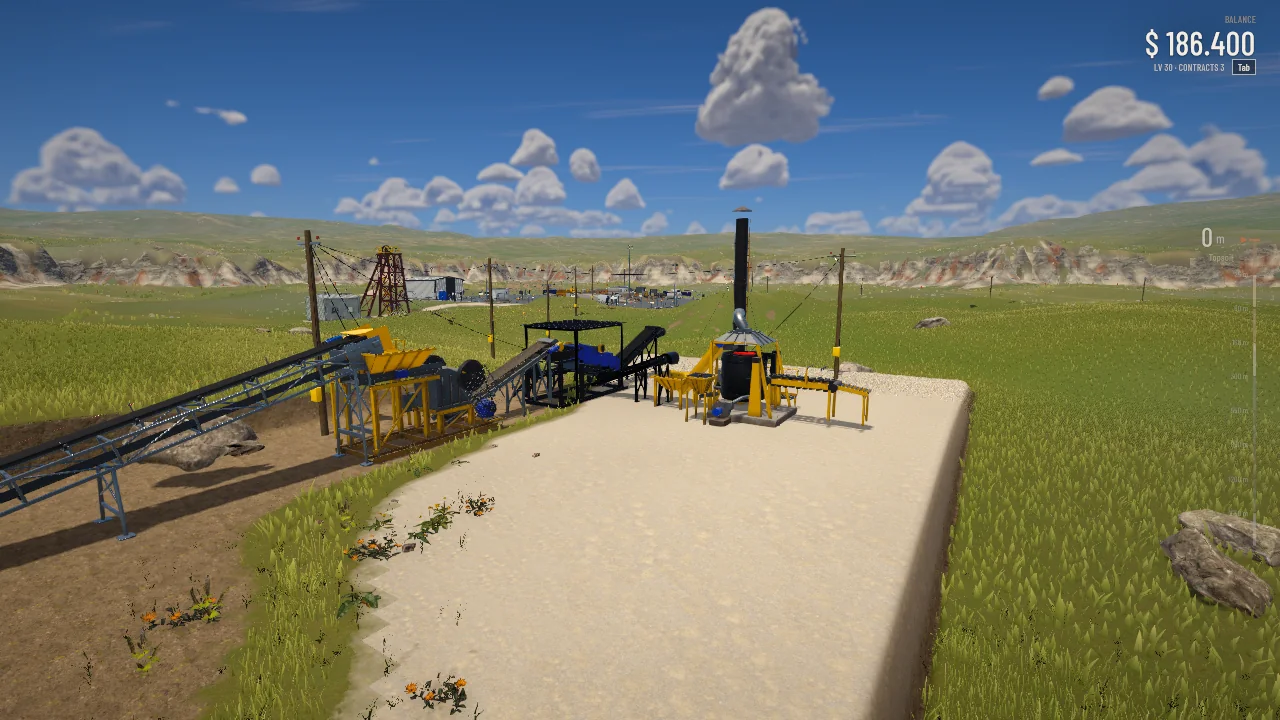
The machines snap to belts. Look at a belt end and place a machine with its hopper under it.
Building underground
The crusher, sorter and auto-digger can be built under a roof. The machine needs headroom:
| Machine | Headroom |
|---|---|
| Auto-digger | 2.2 m |
| Sorter | 3.1 m |
| Crusher | 3.7 m |
| Smelter | 8.5 m (it has a stack) |
If the roof is too low, the game says "Roof too low: ... needs N m of headroom". Dig a taller room, or build the smelter on the surface and send the ore up on the belts.
Backfill
A belt can end under a roof, well below the natural ground, with nothing under it. Waste on that belt then pours onto the floor as a heap of loose fill, which you can use to fill worked-out rooms. Ore lumps are never buried: they follow the normal pour. When the heap gets within 0.35 m of the roof, the belt stops and the status says "Backfill area is full". A single pour point fills a wedge about 5 m long; move or extend the belt to fill more.
Tips
- Put the sorter right behind the crusher so only ore reaches the smelter.
- Check each machine's status text first when something does not run: it names the cause (no power, empty, full).
- Use the electric smelter for platinum, and the coal one for everything else.
- Build one pole near the line before you place machines. See Power and light.