
Water is part of the mine. Below about 80 m the clay layer is soaked, and the ground there lets water seep into whatever you dig. Left alone, a hole fills. This page covers how the water behaves, how to deal with it and how to swim when it catches you.
Where the water comes from
Between 80 m and 160 m (the clay layer) the walls of anything you dig seep. The water comes out of the freshly cut walls, runs down to the lowest point and collects there. It is brown and muddy: you cannot see the bottom through more than a thin film.
When the groundwater starts to seep the game warns you: "Groundwater is seeping in the clay layer! Set a submersible pump before the pit floods."
How fast it rises depends on how much wall you have opened. A narrow sump fills slowly (a quarter of a metre an hour or so), while a big unpumped room can gain many cubic metres an hour. The seepage belongs to the clay layer.
How water moves
- Water runs downhill. It fills a gallery from its lowest point and a shaft from the bottom up.
- It goes over a lip or a ledge, never up a wall.
- If the floor under water is dug out, the water falls down the hole.
- Standing water at rest is still: a pool does not slop around forever.
Pumping out
A submersible pump lifts the water to a settling tank on the surface. The tank lets the silt settle and runs the clean water out into a ditch. A pump does nothing without a tank.
In build mode (B, page Water & air):
| Piece | Price | Power | Notes |
|---|---|---|---|
| Submersible water pump | $1,200 | 4 kW | Put it at the very lowest point of the flooded pit. It reaches about 6 m round it. |
| Settling tank | $2,200 | none | Put it on the surface. |
Both need power: the pump has to be within 30 m of a live pole. A pump lifts less the deeper it works:
| Depth the water is lifted from | Pumped |
|---|---|
| Up to 30 m | 25 m³ an hour |
| 90 m | about 9 m³ an hour |
| 160 m | about 5 m³ an hour |
For a deep sump, or a big room, use two pumps.
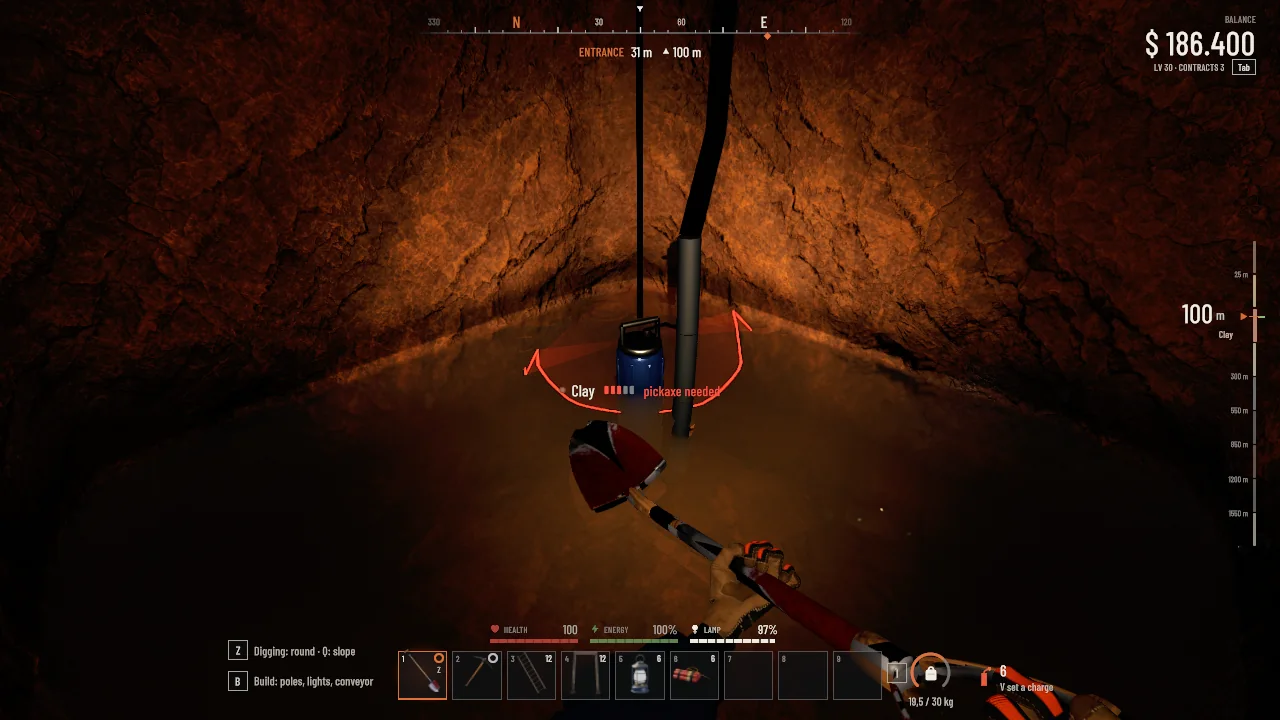
Wading and swimming
Wading. In shallow water you walk, but slowly. From about 25 cm the deeper it is the more it slows you; at chest height you walk at less than half speed.
Swimming. When the water reaches your chest (about 1.25 m over your feet) you lift off the floor and swim. You stay swimming until the water drops below about 1.1 m.
| Action | Keyboard | Pad |
|---|---|---|
| Swim on the surface | WASD in the direction you look | Left stick |
| Swim fast | Shift (costs stamina) | L3 |
| Dive | Ctrl or C | R3 |
| Rise | Space | A |
- On the surface you swim on the flat, at about 1.5 m/s (2.3 m/s fast). Your head rides just above the water.
- When you dive, you swim in 3D in the direction you look, up or down. A heavy bag slows you by up to 40 % and sinks slowly.
- Swimming makes you smaller (about 1 m round the head), so you can swim through a low flooded passage.
- Climbing out. Swim up to an edge that is no higher than about 1 m over the water and you pull yourself out automatically.
- Ladders still grab you from the water.
- You cannot dig, place things or use machines while swimming. The tools are put away.
- Landing in 1.5 m or more of water does not hurt.
Breath
With your head under water your breath bar appears and drains. You have about 30 seconds. Swimming fast under water uses it 1.5 times as quickly. At the surface it refills about four times faster than it drains, so a few seconds at the top gets you back a good part of it.
When the bar is empty you take damage every second and, if your health runs out, you pass out ("You suffocated").
Under muddy water you can see only a few metres, which makes it easy to lose your way. Dive only along passages you know, and come up while you still have at least a third of the bar.
Some worlds have flooded cave passages. When you look at one, the game tells you whether it is short enough to dive through ("Flooded passage: short, dive through it"), has air pockets on the way, or is too long for one breath ("Flooded passage, too long: one breath will not do. Lower the water").
Tips
- Put the tank on the surface and the pump at the very bottom of the flooding pit.
- Pump before you walk into the flooded part.
- Dig a sump off to the side of the gallery on purpose: a deep hole where the water goes and the pump lives, so the gallery floor stays dry.
- Never dive in water you cannot see across. Swim on the surface and look for an edge or a ladder first.
- A ladder at the edge of the water is worth more than a good bag.