A headframe is the tall steel tower over a shaft. In Deep Shaft it comes with a winder house and a four-person cage that runs up and down the shaft and stops at the stations you build. It is how crews, wheelbarrows and mine car loads get between the surface and the deep levels. A second add-on, the skip hoist, hauls rock out in bulk.
The main headframe
In a normal new world a headframe stands by the camp over a shaft already sunk 24 m deep. It does nothing until you buy the cage hoist at the workshop (Site tab, "Cage hoist (headframe)", $28,000, company level 4). The hoist then runs at 4 m/s (faster in worlds with deeper layers) and uses 45 kW, so the winder house needs power: connect it to a generator or a live power pole. If the breaker trips, the cage stops until the load is back under the limit.
The main headframe cannot be taken down.
Another headframe
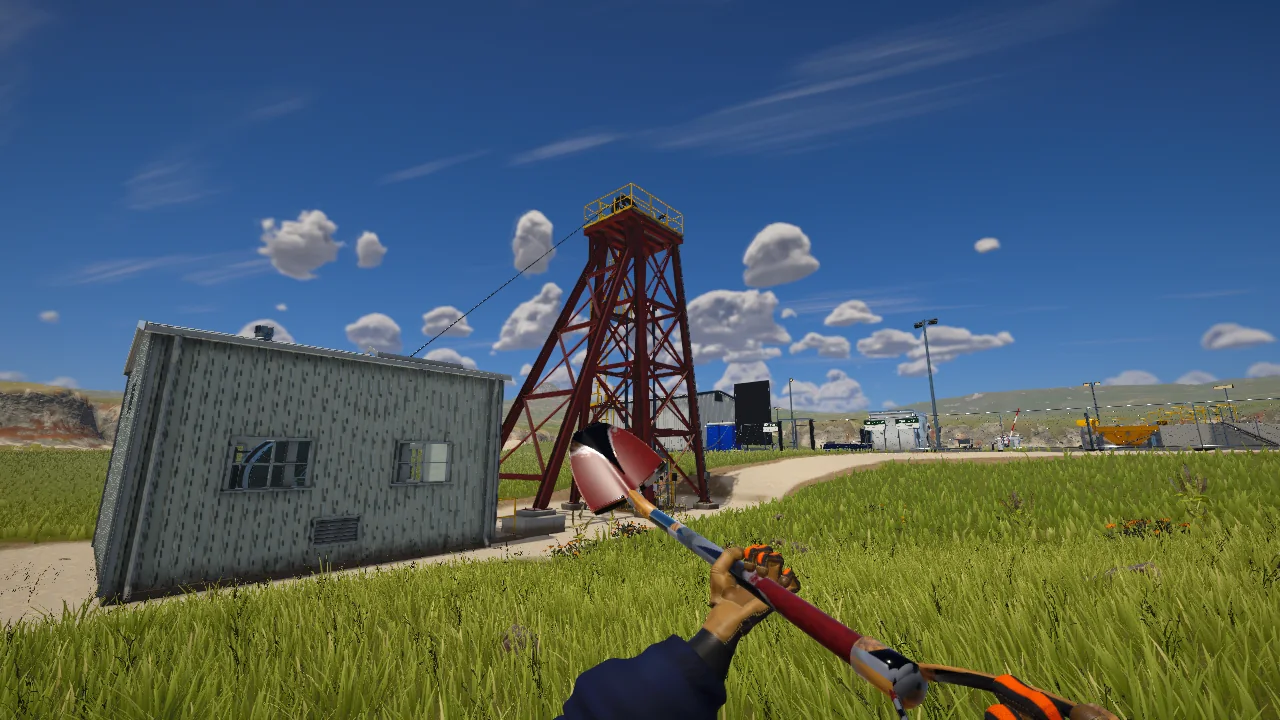
You can set up more headframes over other shafts. Open the build menu with B, go to the Rail & shaft tab and pick "Headframe". The shaft must be at least 6 m deep and wide enough for the cage (2 x 2.6 m). Each extra headframe costs $22,000. A headframe you take down can be built again on another shaft for free (the toast says so).
Riding the cage
The cage holds four people. At the surface or at a station:
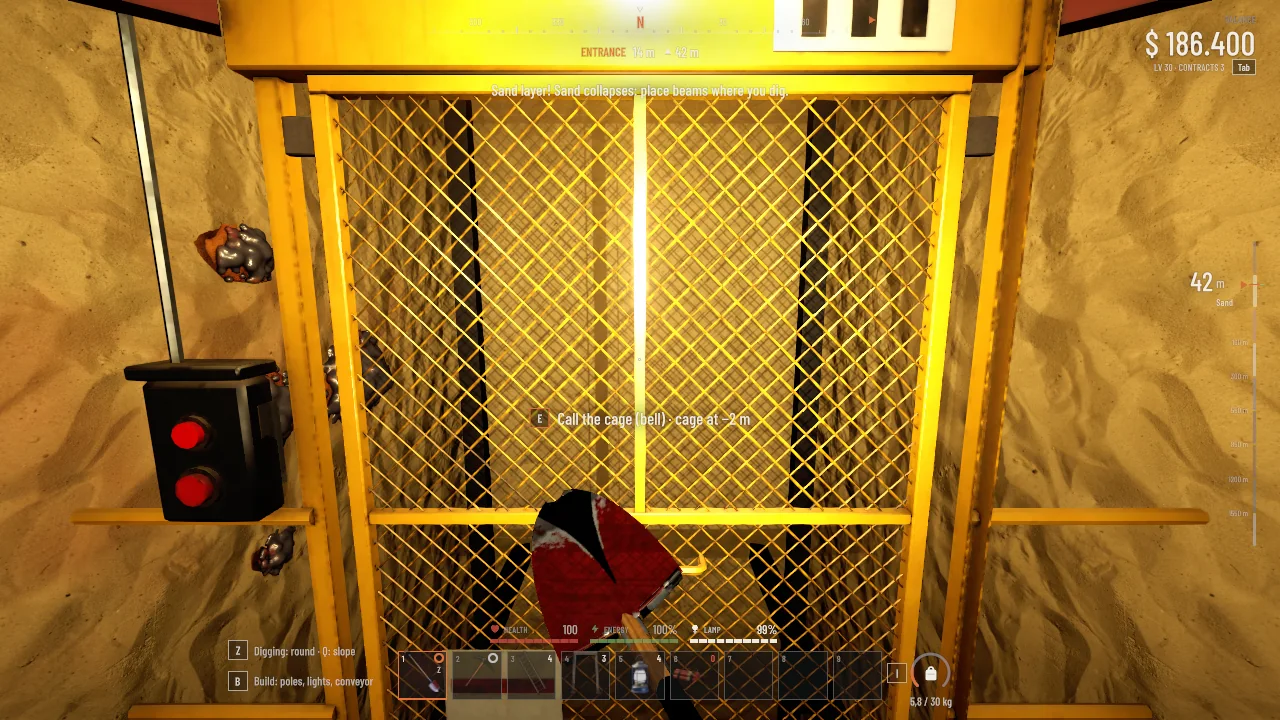
- Go to the gate. If the cage is somewhere else the prompt reads "Call the cage (bell)". Press E: a bell rings and the cage comes.
- When the prompt says "Cage is here: step in", walk in. The gates close behind you.
- Inside, the prompt lists the stops. E sends the cage to the next landing down, R to the next landing up. Hold Shift with either key to go all the way to the bottom or the top.
- The cage shows its depth, speed and destination while it moves. It stops, the gate opens, you walk out.
If you ride up to the surface with ore in your bag, the crew takes it from you and pays you, as they do when you climb out of a shaft (if "Automatic ore hand-in" is on in the settings).
What else rides the cage
- Wheelbarrows: push one into the cage and set it down with E; a parked barrow in the cage travels with it.
- Mine cars can be tipped into the cage: stop a car so that its tipping side faces the open cage and tip it. The cage holds up to 140 units of load, and whatever reaches the surface is unloaded at the bank and sold. A full cage tells you "Cage full: send it up first".
- Big machines (the drill jumbo, the tunnel boring machine, the roadheader) go down the shaft slung under the cage. Drive them within 16 m of the headframe and press G. The shaft must be at least 15 m deep, with a station and 12 m of straight drift at the bottom.
Stations
A cage stops only where there is a landing. The bottom of the shaft is one. For every other level, build a station:
- Dig a tunnel out of the shaft wall at the depth you need.
- Open the build menu (B), Rail & shaft tab, pick "Shaft station".
- Aim at the wall of the cage shaft where the tunnel opens into it. A station costs $1,500 and needs company level 4.
The cage now stops at that level, a landing gate appears, and the label shows the depth ("Station −40 m"). If you dig the shaft deeper, the cage's bottom stop follows.
Skip hoist and measuring pocket
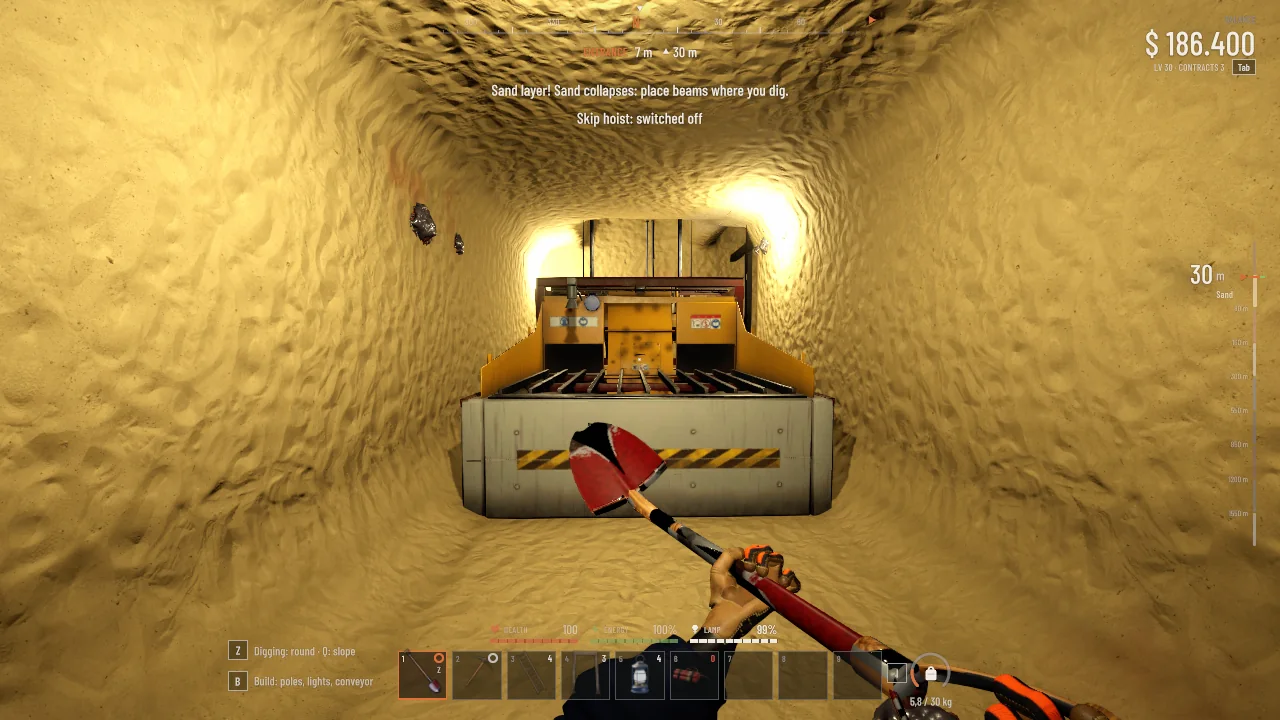
The cage is slow for hauling rock. The skip hoist is a second hoist beside the cage with a 1,000-unit skip bucket that runs at 10 m/s (scaled by depth setting). It needs company level 6.
What you need
- A caged headframe.
- A second compartment dug beside the cage: 2.1 x 2.7 m, 3.3 m from the cage's centre, at least 6 m deep. The build preview outlines it in yellow and counts the metres you have dug.
- The skip hoist itself ($34,000, 75 kW). Open the build menu and look at the tower from the side where the compartment is. The skip bay appears on the side you aim at. One headframe takes one skip hoist.
- A measuring pocket ($8,500, 7.5 kW) built on the gallery floor at the bottom of the skip compartment. The compartment must go 2.3 m below the pocket floor, and the pocket needs 2.6 m of headroom. A compartment has one pocket.
- Power for both.
How it works
Feed the pocket with a conveyor head, the outlet belt of a dump station, or a loader tipping into it. The pocket weighs the load into the skip. The skip takes about 1.5 s to settle, loads, rises, opens its bottom door at the top and empties into the head chute. A part load leaves after 20 s without new rock (at least 150 units). The head chute holds 1,500 units and feeds an outlet belt: the start of a conveyor line. If the chute is full the skip waits at the top ("Chute full").
The skip hoist reports why it is standing: no power, no pocket, compartment too shallow, chute full, or "Someone is in the skip's path" when a player is under it.
Roughly how much a skip moves, in units a minute (the feed and belt must keep up):
| Shaft depth | Units a minute |
|---|---|
| 150 m | 940 |
| 300 m | 640 |
| 600 m | 390 |
| 900 m | 280 |
| 1,200 m | 220 |
| 1,500 m | 180 |
A standard 1.2 m/s conveyor carries about 280 units a minute, so beyond about 900 m the belt is the limit; upgrade the belt drive.
Controls
| Key | Action |
|---|---|
| E | At a gate: call the cage. In the cage: go down one landing |
| R | In the cage: go up one landing |
| Shift + E / R | In the cage: all the way down / up |
| G | Near the headframe, driving a deep machine: lower it down the shaft |
Tips
- Build a station at every level you work on before you dig the next drift: it is cheap and saves long ladder climbs.
- Keep the cage clear of the skip compartment's side: players under a moving skip stop it.